A 10.9 bolt carries roughly 30% more tensile strength than a standard 8.8 fastener, at only a small increase in cost. That margin decides whether a flange holds under vibration or a joint works loose after a few thousand cycles. Engineers reach for this grade whenever repeated stress, heat, or shock load define the job, and understanding why starts with the numbers behind the marking. Automotive suspension mounts, structural steel connections, and heavy machinery frames rely on this same property class because the failure mode shifts from sudden snapping to predictable fatigue.
What is a 10.9 Grade Bolt?
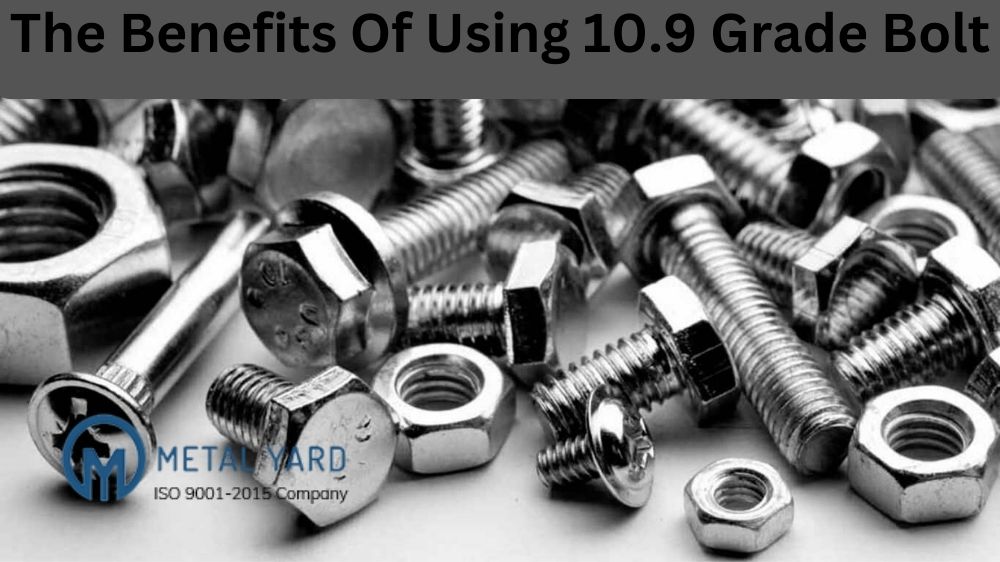
Grade 10.9 bolts carry a minimum tensile strength of 1,040 N/mm² and a yield strength near 940 N/mm², placing them above 8.8 and just below 12.9 on the ISO 898-1 strength scale. Manufacturers forge them from alloy steel, then quench and temper the finish to lock that strength into the material. Diameters typically run from M5 to M16 in stock catalogs, with larger sizes available on request. Each 10.9 bolt carries the “10.9” marking stamped on the head, so a technician can confirm the grade on site without pulling a spec sheet. Metric threading follows the ISO standard across the range, which keeps nut and washer selection straightforward for maintenance crews working across mixed equipment fleets. Most catalogs list a bolt 10.9 grade separately from 8.8 and 12.9 lines, since the coating options and lead times differ between them.
Superior Tensile Strength
Every 10.9 bolt meets a minimum tensile rating of 1,040 N/mm², close to 150,000 PSI, verified against DIN 931 and ISO 898-1 test methods. That number shows up in the field, not just on paper. A 4.6 or 8.8 bolt strips its threads or shears well before a grade 10.9 bolt approaches yield, which is why lower grades stay out of driveline assemblies, structural steel connections, and pressure vessel work. Mills proof-load test every batch before shipment, and reputable suppliers include a certificate of conformance so the figures trace back to the heat number.
Corrosion Resistance
When fasteners sit exposed to saltwater, condensation, or industrial runoff, the base alloy and coating decide how long the joint lasts. Grade 10.9 bolts typically ship with a zinc-plated or hot-dip galvanized finish that slows oxidation, and stainless variants cover marine decks and offshore platforms where standard coatings fail fast. Corrosion thins a fastener’s cross-section long before it looks damaged. A properly finished 10.9 bolt resists that thinning for years longer than an unplated equivalent in the same environment. Coastal fabrication yards and wastewater plants both specify grade 10.9 bolts with a heavier zinc-nickel coating for exactly this reason.
Temperature Resistance
Engine blocks, boiler flanges, and furnace housings all cycle through heat that would deform a lower-grade fastener. A bolt 10.9 grade rated for continuous service up to 150°C holds its clamp load through that cycling without backing off. Thermal expansion works against every bolted joint, but a correctly torqued 10.9 bolt spreads that stress across the full thread engagement instead of concentrating it at one point, which keeps the joint tight through repeated heating and cooling.
Better Joint Integrity
A full-bodied shank on a grade 10.9 bolt spreads load evenly across the joint face, keeping clamping force consistent even under vibration. Loose joints usually fail from fatigue rather than sudden overload. A correctly rated 10.9 bolt resists that fatigue cycle far longer than a lower-strength substitute, which means fewer retorque visits and fewer unplanned shutdowns on rotating equipment. Torque specifications matter just as much as the grade itself; over-torquing a grade 10.9 bolt past its proof load defeats the purpose of specifying it in the first place.
Cost-Effective Solution
Unlike premium 12.9 fasteners, a 10.9 bolt costs only marginally more than an 8.8 equivalent while delivering a real jump in load capacity. That difference pays for itself the first time a lower-grade bolt would have needed early replacement. Fewer replacements mean less downtime, and downtime, not the sticker price of the fastener, drives the real cost of a failed joint. Buying grade 10.9 bolts in bulk from a stocked supplier also cuts per-unit cost well below what a specialty order for 12.9 would run.
Mechanical Properties of 10.9 Grade Bolt
|
Property |
Value |
|
Tensile Strength |
1,000 MPa (min) |
| Yield Strength / Proof Load |
900 MPa (approx.) |
|
Hardness |
Rockwell C 32–39 |
|
Material |
Medium-carbon / low-alloy steel |
|
Thread Standard |
ISO Metric |
Strength Class / Property Class Definitions
| Class / Grade | Material & Heat Treatment | Minimum Tempering Temperature |
|
8.8 |
Low-carbon alloy steel, quenched & tempered |
425 °C |
|
10.9 |
Medium-carbon / low-alloy steel, quenched & tempered |
340 °C |
Proof Load / Yield Strength Calculation
| Property Class | Calculation Method | Example (10.9) |
| Tensile Strength (nominal) |
First number × 100 = MPa |
10 × 100 = 1,000 MPa |
|
Yield Strength |
(Second number / First number) × nominal tensile | 9 / 10 × 1,000 = 900 MPa |
Typical Applications by Bolt Grade
| Bolt Grade / Property Class | Common Applications |
|
SAE Grade 8 |
Automotive suspension, heavy equipment, high-stress joints |
|
ISO 10.9 |
Structural connections, high-strength friction joints, industrial machinery |
Comparison: Grade 8 vs 10.9 Bolts
| Feature | Grade 8 Bolt | 10.9 Bolt |
|
Material |
Low-carbon alloy steel |
Medium-carbon / low-alloy steel |
|
Heat Treatment |
Quenched & tempered |
Quenched & tempered |
|
Tensile Strength |
~1,034 MPa |
1,000 MPa |
|
Yield Strength |
~897 MPa |
900 MPa |
|
Hardness |
Rockwell C 33–39 |
Rockwell C 32–39 |
|
Applications |
Automotive, equipment, high-stress joints | Structural, industrial, precision high-load applications |
Conclusion
Reach for a 10.9 bolt whenever the joint faces vibration, heat, or repeated load cycles that a 4.6 or 8.8 fastener can’t handle reliably. Check the head markings, confirm the diameter against your spec sheet, and match the finish to the operating environment before ordering. Confirm that any grade 10.9 bolts on hand match the specified diameter and thread pitch before installation, then request a datasheet from your supplier to verify proof load.