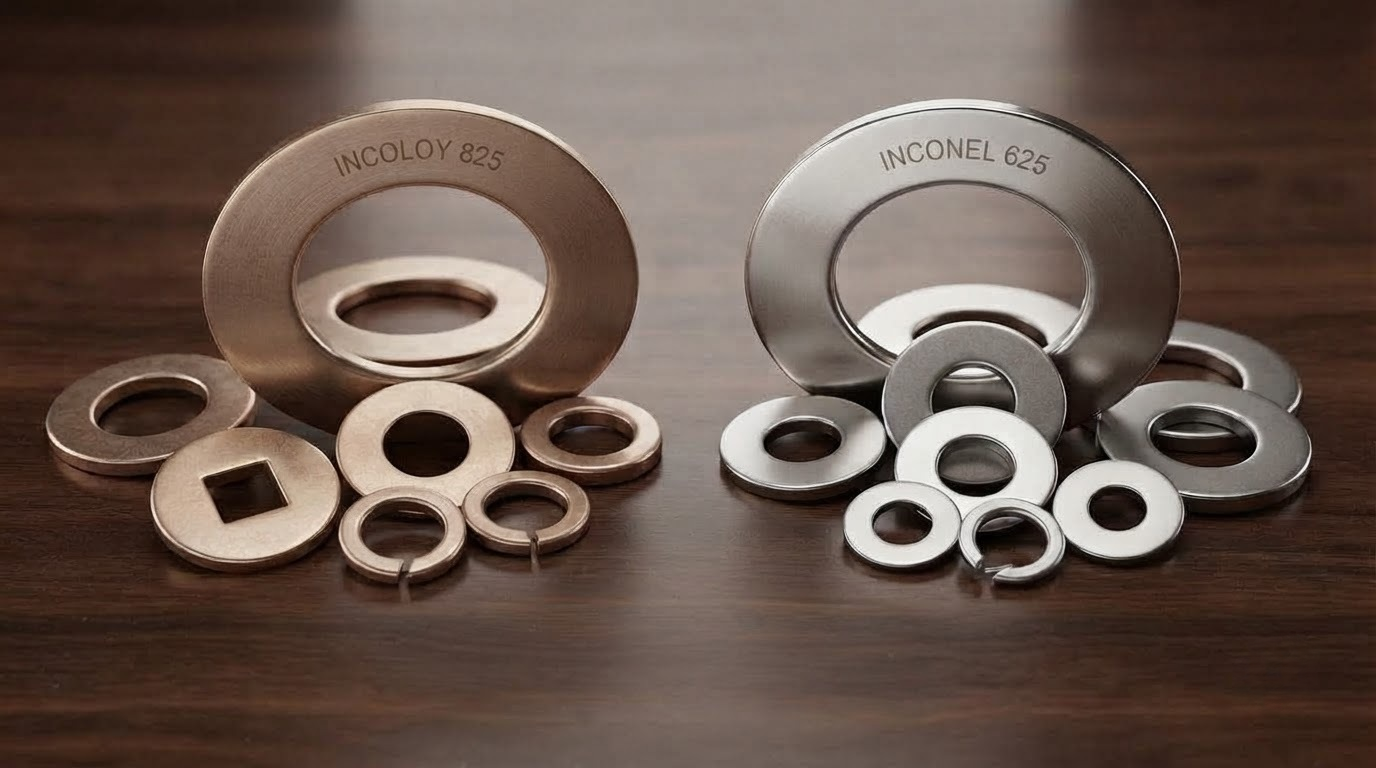
Incoloy 825 and Inconel 625 washers differ in chemistry, mechanical strength, and corrosion resistance, making each suitable for different demanding industrial environments. Assuming one alloy is universally better than the other can lead to incorrect material selection. The right choice depends on factors such as temperature, corrosive exposure, mechanical loads, and application requirements. For Incoloy 825 washers supplier, buyers should also select a supplier that can provide the required material grade and specifications.
Incoloy 825 vs Inconel 625: Key Differences
| Factor | Incoloy 825 | Inconel 625 |
| Alloy Designation | UNS N08825 | UNS N06625 |
| Primary Alloying Elements | Nickel, iron, chromium, copper, titanium | Nickel, chromium, molybdenum |
| Corrosion Resistance | Strong in reducing acid environments | Strong against chloride pitting and crevice corrosion |
| Mechanical Strength | Good | Generally higher |
| Temperature Capability | Suitable for moderate service temperatures | Suitable for more demanding temperature conditions |
| Typical Service Environment | Sulfuric and phosphoric acid processing | Seawater, chloride-rich, high-corrosion service |
| Material Selection Consideration | Broad corrosion resistance across reducing acids | Higher strength and severe-condition performance |
The difference in alloy chemistry helps explain these performance differences. Inconel 625 carries substantially higher molybdenum and nickel content, which is what gives it its edge in chloride and seawater exposure. Incoloy 825, on the other hand, contains copper and titanium additions that specifically improve its performance in reducing acid environments like sulfuric and phosphoric acid a role 625 isn’t optimized for in the same way.
Corrosion Resistance: Which Washer Performs Better?
Neither alloy is clearly superior; the choice depends on the washer’s actual exposure. Incoloy 825 is particularly useful in sulfuric and phosphoric acid environments, where its copper and titanium content provides real protective value. Inconel 625, by contrast, offers stronger resistance to chloride pitting, crevice corrosion, and seawater exposure, making it the more reliable choice in marine or chloride-heavy service. Either alloy should therefore be selected according to the actual chemical environment and service conditions.
Strength and Temperature Performance
Mechanical strength and temperature tolerance also diverge between the two. Inconel 625 is generally selected where higher strength and more demanding temperature conditions are required, supported by its alloy chemistry and mechanical properties. That does not mean Incoloy 825 lacks strength; it performs effectively within its intended service range. For washers exposed to higher mechanical loads and elevated temperatures, Inconel 625 may be considered where its specified properties meet the application requirements.
Which Alloy Should You Choose for Washers?
A practical way to approach the decision:
- Choose Incoloy 825 where broad corrosion resistance and reducing-acid service are the main requirements.
- Consider Inconel 625 for chloride-rich, seawater, high-strength, or more severe corrosion conditions.
- Final selection should weigh temperature, chemical exposure, mechanical loading, washer dimensions, and the applicable specification together, rather than picking based on one factor alone.
What Should Buyers Check Before Ordering?
Beyond the alloy itself, a few practical details determine whether the washer actually fits the job. Confirm the grade and applicable standard washers in this category are typically specified against ASTM B425/ASME SB425. Verify dimensions and washer type against the drawing, and check available sizes, which commonly run from M3 to M56 with custom sizes available where standard options don’t fit.
Quantity, material certification, testing requirements, and traceability round out the checklist. Material should come with EN 10204 3.1 certification as standard practice, giving buyers documented proof that what’s supplied actually matches what was ordered. Working with an established Incoloy 825 washers supplier makes it easier to confirm all of this upfront rather than discovering a mismatch after the material arrives.
Incoloy 825 and Inconel 625 washers are not interchangeable because they are both nickel alloys. The proper option depends on the corrosive environment, necessary strength, operating temperature and other specification parameters that are worth confirming carefully before placing an order.