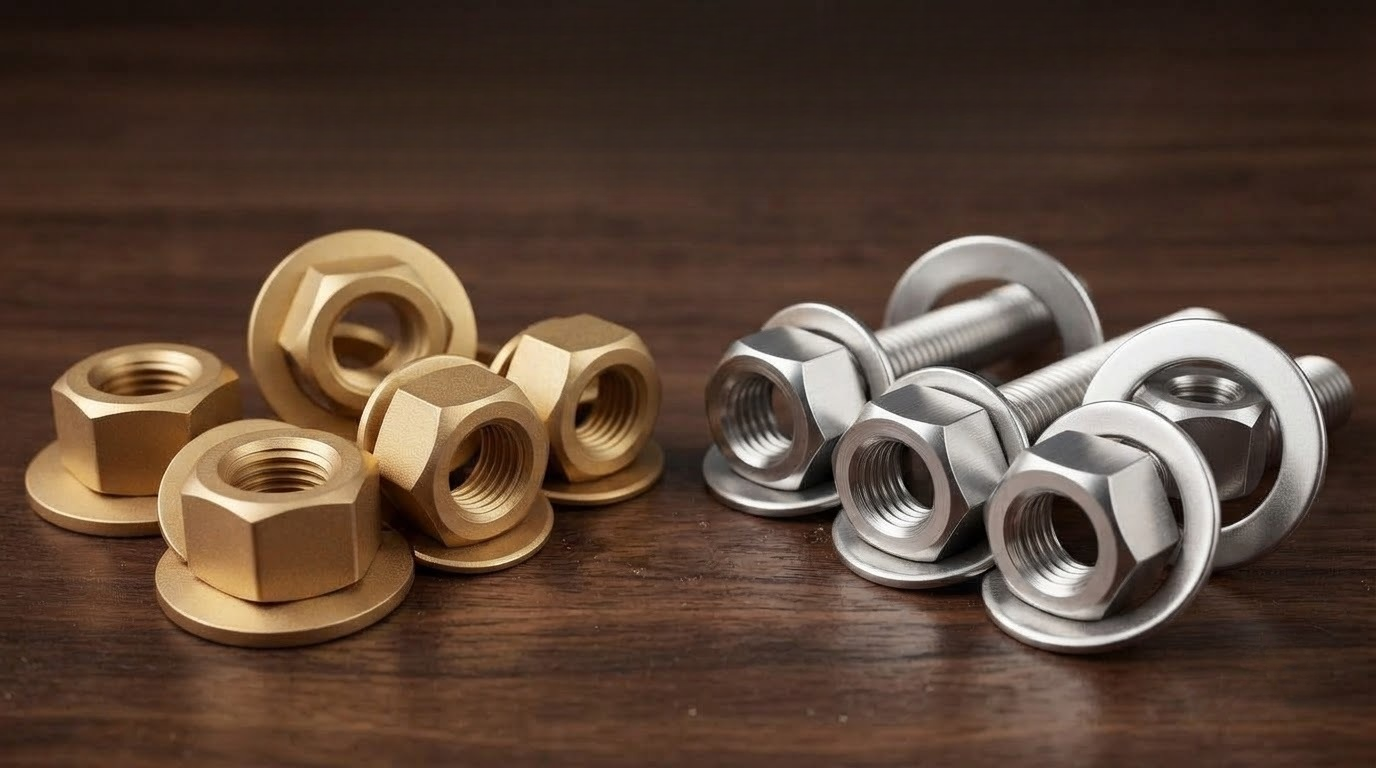

A2-70 vs A4-70 fasteners are a common comparison, as both have a lot in common, but their differences are crucial. Both are low‑carbon austenitic stainless steels with excellent corrosion resistance. They are non-magnetic, highly ductile, and easy to weld; therefore, they are widely used for manufacturing process.
The key difference between A2 70 vs A4 70 is that A2-70 bolts have better machinability than A4-70, which makes them easier to work with. Both can be hardened by cold working, but A4-70 has the additional advantage of being able to be hardened by heat treatment as well.
A2 and A4 materials are grades of stainless steel. Both grades exhibit the same strength, ductility, and toughness as ordinary steel but can withstand corrosion because of their chromium content.
A2 material is heat treatable with an approximate 10.5% chromium content to provide a tougher material. This material has better corrosion resistance than A4 material and less corrosion resistance than regular steel. Thus, its use is most common in applications where corrosion is an important, but not primary, consideration.
The A4 material has approximately 18% chromium, providing a greater corrosion resistance than the A2 material or regular steel. Thus, it is used for marine-grade applications because of its high corrosion resistance.
These are cold-worked austenitic stainless steels, and they come in a variety of subgrades, including a2 70 vs a4 70. Typically the numbers indicate the minimum tensile strength of the part in megapascals (MPa). Besides high temperature resistance, both A4-70 mechanical properties and A2 have a minimum tensile strength of 700 MPa.
A4-70 is a generic designation according to the international standard ISO 3506-1 for fasteners made of corrosion-resistant austenitic stainless steels. The alphanumeric designation gives direct information on the chemical group of the material and the mechanical strength class: “A4” means that the fastener is made of molybdenum-bearing austenitic stainless steel (usually Grade 316 or 316L) with superior resistance to pitting and chloride corrosion. The suffix “70” is the property class and means that the fastener has been cold worked to a minimum tensile strength of 700 MPa.
In contrast, high temperatures can produce the precipitation of chrome carbide, which reduces the materials’ corrosion resistance. On the other hand, heated and cooled materials are harder and more resistant to corrosion, allowing them to be used in food processing, transportation, and other industries.
The A2 grade is a more general-purpose material that may be utilised in household and broad corrosive-duty applications. A4 is a higher grade of stainless steel than A2 or A3 and is suitable for use in more corrosive environments, such as ocean water, saltwater, and food-grade and surgical devices.